


Was There Ever A Balance?
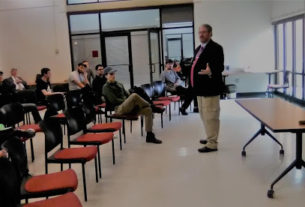
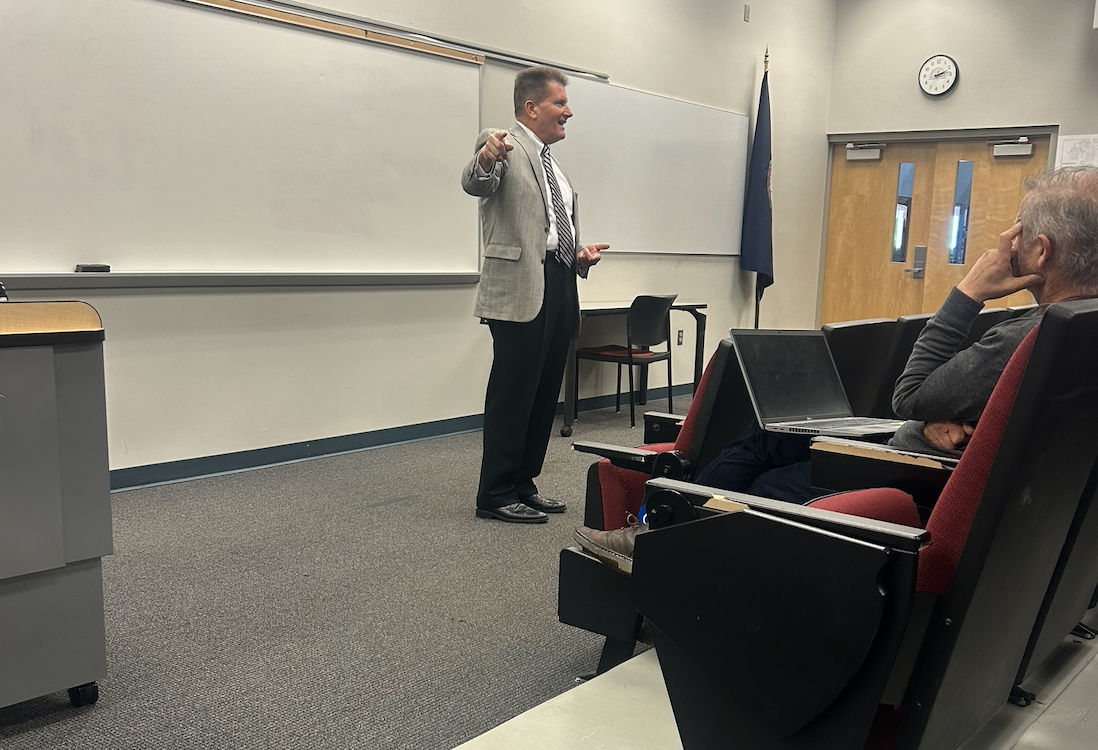
On March 4, Dr. James Sofka delivered a lecture at PVCC discussing the history of Europe’s balance of power that led to the Russia-Ukraine war. The topic of discussion also held a certain gravity because, as of Feb. 24, 2026, the war in Ukraine officially entered its fourth year of conflict. Ukraine, having lost its “sensational status” in the U.S., has suffered a drastic lack of coverage from major U.S. media outlets, leading to the war falling out of focus. This lack of attention has become even more exacerbated by the U.S. war in Iran becoming a focal point for war-related news in America, with almost daily updates. Lectures like Sofka’s offer a tool for not just students but for all Americans living in the reality of warring nations: the ability to better understand these conflicts.
Sofka, who has taught at institutions such as the Brookings Institution and the University of Virginia, specializes in international relations. His lecture focused on the “security strategies” global powers began implementing after the fall of the USSR and the reunification of Germany in response to the new and uncertain political landscape. Those powers (France, Germany, the United States, and Russia) each took a different approach to this new landscape. In simplifying the series of events, Sofka said, “Like a Rorschach test, all four countries are looking at the same map and seeing different things.”
Beginning with France, it saw the fall of the USSR and the establishment of the newly freed Baltic nations as “more Europe.” France looked at the idea of “more Europe” as a means of strengthening French influence in the region. More European nations also meant a greatly enhanced European Economic Community (an organization later incorporated into the EU), which France had influenced since its inception in 1957. The French later used that influence to help orchestrate the 1991 Treaty of Maastricht, which called for a common currency that later became the euro in 1999. The treaty also became the foundation for the European Union. “The idea was that the new Germany would be safely ensconced in international institutions, which had worked very well for France since the 1950s,” Sofka said.
Sofka then transitioned to the German strategy. “The German view was to work with France on the EU on the assumption they would eventually influence the European Central Bank (ECB) and euro,” he said. Germany aimed to invest heavily in the former Soviet-occupied states of Eastern Europe, with capital newly available to it thanks to the ECB, while also taking advantage of the region’s industrial base and cheap labor force, which would serve as the “factory floor” for German manufacturing; this is also why major German manufacturers like BMW and Volkswagen still have extensive manufacturing operations in Eastern Europe. But to do that initially, Germany needed a close relationship with Russia, as they would effectively be amassing German influence right on Russia’s border. With their close relationship with Russia cultivated over decades, Germany successfully integrated those former Soviet states into the EU from 2004-06, shifting the coalition’s center of power away from France towards the east.
The American strategy was one that has been consistently chosen over time: show military superiority over Russia. America’s goal was largely to circumvent the EU while focusing on NATO as the main factor in European policy. The reason for doing this was, as Sofka said, “like the EU for France up to the late 1990s, NATO was an organization that the US effectively managed.” This demonstrates that U.S. intentions for Europe were not to facilitate its transition toward a time of peace, but rather to strengthen institutions that allow America to have a direct effect on Europe and, by extension, Russia.
The enlargement of NATO led to great relations between America and Eastern European nations like Poland, but was also the source of growing hostility from Russia. The idea of NATO on Russia’s border jeopardized the harmonious relationships Russia had with countries like Germany and France. This hostility led both France and Germany to block Ukraine and Georgia from joining NATO in 2008.
Even with the threat of NATO, Russia depends on Europe economically, as its security strategy showed. Russia wanted to work with Europe, especially Germany, for access to technology and a market for its natural gas. Sofka illustrated that the goal in this new relationship with Europe was to build diplomatic capital that Russia could use to stifle the American NATO project at its borders. Sofka said Putin’s invasion of Ukraine stemmed from doubts that building capital to fend off NATO expansion would work indefinitely, believing that an invasion of Ukraine would force the topic of NATO back to the negotiating table.
“Putin hoped a decisive win in Ukraine would make this a fait accompli, but it doesn’t work as intended, and Russia created the worst-case scenario for itself — a bigger, better-armed NATO, and a break with his cozy relations with Paris, London, and especially Berlin, as well as a catastrophic war,” said Sofka. Sofka suggested that Russia felt very confident about its chances during the initial invasion. So much so that Russian troops actually carried ceremonial uniforms traditionally worn for events like military parades in their rucksacks as they believed Russia would conquer the city of Kyiv, Ukraine, in a matter of weeks, and planned to hold a military parade through the city.
While the war in Ukraine continues to be waged in Europe, the war between the United States and Iran continues in the Middle East. Both seem largely unrelated, but the blockade of the Strait of Hormuz (the shipping lane responsible for transporting one-fifth of the world’s oil), as well as the bombing of Kharg Island by the U.S. (responsible for exporting the majority of Iran’s oil), has sent oil prices over $100 a barrel. The drastic spike in the price of oil led to the U.S. easing sanctions on Russian oil to offset the war in Iran’s effect on the market.
When asked about these developments, Dr. Sofka said, “High oil prices are an early Christmas present for Putin — Russia can replenish currency reserves, drained in the Ukraine war, and boost Russia’s shaky economy. Also, the U.S. temporary waiver on sanctioned Russian oil already on tankers is an added bonus for two reasons — first, it increases revenue, and second, it creates a fissure between Washington and European capitals. Putin has tried to drive a wedge between Ukraine’s allies, and this offers him a tool.” So the war between Iran and the U.S. (prompted by Israeli aggression towards its neighbors) is actually having positive effects on the war in Ukraine…for Russia.
The scale and complexities of these conflicts make it difficult for people to truly understand what is happening at any given point in the conflicts. That exact sentiment is why these events are so important for Kris Swanson, PVCC coordinator of international education, who was also the organizer for Dr. Sofka’s lecture and countless others. When asked why having these events at PVCC was so important to her, she said, “It will become more and more necessary in an ever-changing world for students to be able to understand and navigate the global landscape. While our hope is that students will venture out and explore other lands and cultures through international travel, we know that is not always feasible. We can, however, bring the world to PVCC through an internationally themed speaker series in the fall and spring semesters…My hope is that the attendees will walk away with an increased understanding of the topic and questions. A certain curiosity is necessary for continued learning, which we hope will happen! The more people learn, the more engaged they become in their own culture and the world.”