


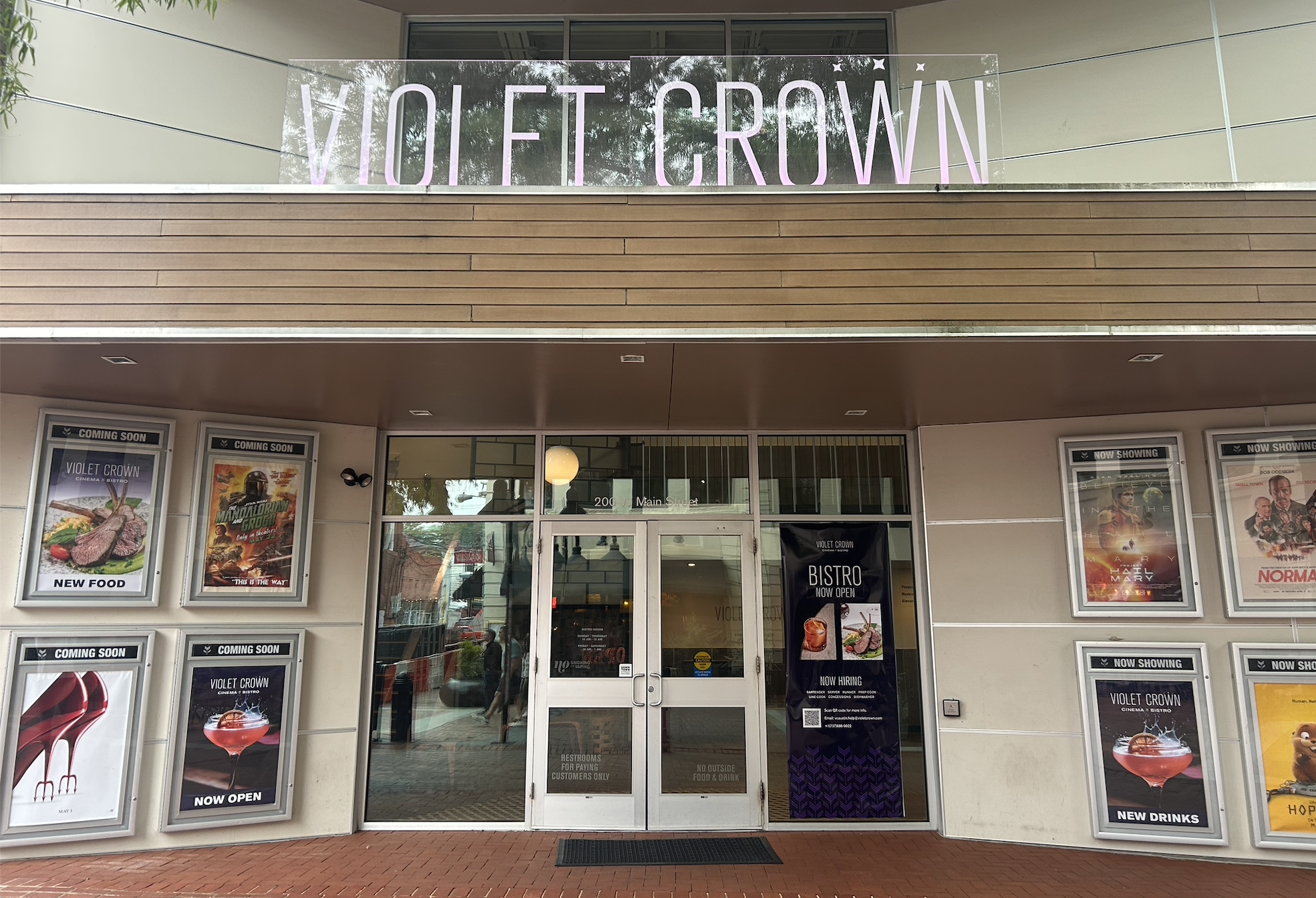
The Decline of Cinema & The Fate of Violet Crown
I still remember the feeling I got whenever my father took my brothers and me to the local theater as children. That pit of excitement mixed with the slight unease of being allowed to stay up late to watch movies made it feel like you were doing something that wasn’t allowed, which made the experience even more thrilling. That nostalgic feeling I get while writing this is tied to some of my most valued childhood memories. Which is why it was unfortunate to hear rumors that a Charlottesville staple like the Violet Crown Cinema on the Downtown Mall might be closing permanently in 2025, preventing others from having the experiences I hold so dear.
The COVID-19 pandemic of 2020 was one of the most economically impactful periods in recent history. Naturally, companies had to adjust the way they operated or risked falling apart, and movie theaters were no different. As businesses reliant on individuals gathering in an enclosed space, the abrupt inability to do so rendered the movie theaters inoperable for most of the pandemic. Even with the easing of lockdown restrictions, the industry never fully recovered.
In 2025, the Pew Research Center found in a survey that only a little over half of Americans (53%) had been to a movie theater in the past year, with ticket sales still being less than half of what they had been in 2002. The numbers simply reflect the problem that people don’t want to go to theaters anymore. But it’s been half a decade since the pandemic, so if COVID isn’t the main factor, then what is?
The rise of streaming has been one of the most impactful reasons. The Los Angeles Times found that in 2020, streaming subscriptions had jumped to over 1 billion members, a 26% increase from 2019. Because of this and the lack of having to pay for a physical event space, studios made, on average, 80% of the total revenue a movie generated from rental fees on streaming sites compared to the 40-50% they would receive in ticket sales from theaters, according to a report from Medium. Also, the convenience of streaming disincentivizes many from paying to see a movie in theaters, as they can just wait a month for it to appear on streaming services.
The move toward streaming and away from theaters gave Heirloom Development, led by Jeffrey Levien, the opportunity to claim that Violet Crown was “outdated” and better suited for residential space, so Levien’s company proposed a 184 ft building with 150 market-rate units. For a building to rise above 142 feet in Charlottesville, Charlottesville’s Development Code requires that at least 10% of the total number of units must be classified as affordable housing and income-restricted for a minimum of 99 years. Although Levien said he aimed to exceed affordable housing requirements, public filings did not specify how those commitments would be met. Eventually, his development plan was abandoned, and the fate of Violet Crown was once again uncertain.
That was until three Charlottesville locals, Annie Galvin, Rachel Baker, and Lindsay Meck, coordinated with the city to save the theater. Galvin, who works as the producer of the Ezra Klein Show, recently answered some of my questions regarding the work her group did to preserve the theater and ways the theater serves as an important space for our community.
Galvin recounted what it was like when learning their group’s efforts had been a success, saying, “Honestly, we were just really happy. I mean, it’s a huge responsibility to acquire a property and ensure that everything is functioning well, so it was a bit intimidating, I’ll admit. But we had a sense that people would be happy and relieved that the theater will remain, and luckily, that has been the case. Whenever I go to the Violet Crown — and I go often! — I take a moment to appreciate all that I love about it, from the tasteful design to the comfy seats to the wine offerings and, of course, the movies themselves. I’m just really glad that our city can enjoy movies and community downtown for years to come.”
When asked what made Violet Crown an important addition to the Downtown Mall, she said, “For a small city, Charlottesville has a remarkably rich downtown arts scene. The Downtown area is home to music venues, art galleries, and other theaters, including Live Arts and the Paramount. The Violet Crown rounds out the downtown arts corridor by bringing accessible film experiences to our city. While we also have a Regal and an Alamo in town, Violet Crown is unique because it screens a mix of blockbusters, mid-budget movies, and smaller art-house, foreign, and documentary films. You can really see anything you want there. It also devotes about 8 screens to the wonderful Virginia Film Festival, which drew over 23,000 attendees in 2025.” So, while not the biggest theater in town, Violet Crown offers independent films an outlet to find an audience and directors an opportunity to showcase their work. But, despite that, does it serve a purpose outside of just being a place to watch movies? Yes.
When asked how, Galvin said, “Movie theaters can function as important ‘third spaces’ in cities or towns: spaces that aren’t home or work but where people can gather to relax, socialize, and build community. Seeing movies together is a profound communal experience: everyone puts their phone away for 2 hours and focuses on the same thing. I recall seeing the Oscar-nominated documentary Come See Me in the Good Light (about poet Andrea Gibson’s battle with cancer) in a packed VC theater during the Film Festival; my friend and I were handing out tissues to strangers in our row. It was an amazing experience to watch such an emotional film alongside friends and strangers alike.”
So movie theaters not only serve as entertainment or as a brief escape, but also as important spaces in strengthening solidarity within the community through shared experiences. That sense of community in theaters seems to only be getting stronger as children have been a large factor in the revival of the theater business.
On the topic of the theater experience for the next generation, Galvin said, “I’ve recently learned something really cool: Gen Alpha is more excited about going to the movies than any other generation. That totally makes sense to me: all of us are awash in digital culture, with smartphones and social media claiming our attention constantly. But young people are totally native to that culture; it’s all they’ve known. I get the sense that young people are looking for spaces and experiences where they can take in great art/entertainment in the company of others.”
When asked how she thought Violet Crown’s preservation would affect the new generation of movie-goers, she said, “I would highly encourage young folks to head to Violet Crown to see a movie, alone or in a group. It’s just completely different from streaming at home or certainly than watching on a phone: directors like Martin Scorsese, Ryan Coogler, Sean Baker, and others have talked about how they make movies to be seen in theaters, so it’s the best possible way to watch a film.”
In a closing thought, Glavin said, “And personally speaking, in a theater I can focus on the film way better than I can at home. Going to the movies is truly one of my favorite parts of my life, and I hope others can enjoy the theatrical experience as much as I do!”