

TechnoSonics 2025: Cville’s Taste of the Future in Music Technology
The sound of rushing water played through speakers as a string quartet produced haunting and thought-provoking tones. The whooshing of wind chills the air as the quartet plucks demanding melodies representing melting glaciers in a piece entitled “Ice Becomes Water” by Judith Shatin. Later in the evening, ticking metronomes were projected on the screen as a piano accompanist played hurriedly, then slowly, as the time keepers rushed and dragged in “Maelzels Metronome(M.M.)” by Lawton Hall. For an average music fan, these scenes may have been unexpected when hearing of an electronic music festival, but this concert was a culmination of years of research, music composition, and artistic expression through technology.
Futuristic music filled one of UVA’s first concert halls early this November with their 26th annual TechnoSonics (TSX or TSX XXVI) performance. Produced by UVA’s Music Department, they describe it as a “festival of electronic and acoustic music, installation, and intermedia arts.” From November 10 -14, TSX spread out across Charlottesville with events such as daily light and sound performances at the Contemplative Commons Center, and two showcases from the Composition and Computer Technologies (CCT) program’s graduate students, faculty, and staff.
Members of the CCT program at UVA specialize in combining acoustic, electric, and computer sounds to create intricate music and art. TXS performers spent the past year producing cutting-edge musical art pieces by incorporating motion capture technology, engineering new instruments, and researching biological and environmental science. These unique combinations allow students to produce a diversity of emotion-provoking sounds.
This year’s first concert showcase took place in Old Cabell Hall, one of UVA’s original campus buildings, completed in 1898. The Music Library and the Department of Music have both been housed in Old Campbell Hall since 1951, allowing CCT students to put on performances in a designated concert hall.
Massive timpani drums, grand pianos, and five octave xylophones were just a handful of instruments scattered across the stage as performers played in the spotlight. In addition to the classic orchestral instruments, CCT performers engineered unique inventions for their pieces. In Monster Voice by Jennifer Ryu, a harness-like mechanism distorted synthetic vocals and sounds when the wearer tilted their head or body. Representing “generations of women who have attempted to verbalize their pain,” according to Ryu, the use of custom-built body-worn instruments allows artists like them to truly embody their cause. In Moon via Spirit, composer and performer Lauren Sarah Hayes used a retro gaming controller connected to their microphone and audio looper to improvise an otherworldly landscape of sounds. These pieces each require unique programming and live adjusting in order for the desired sounds to be produced, like having to build a guitar from wood, then tuning every time a string gets plucked live on stage.
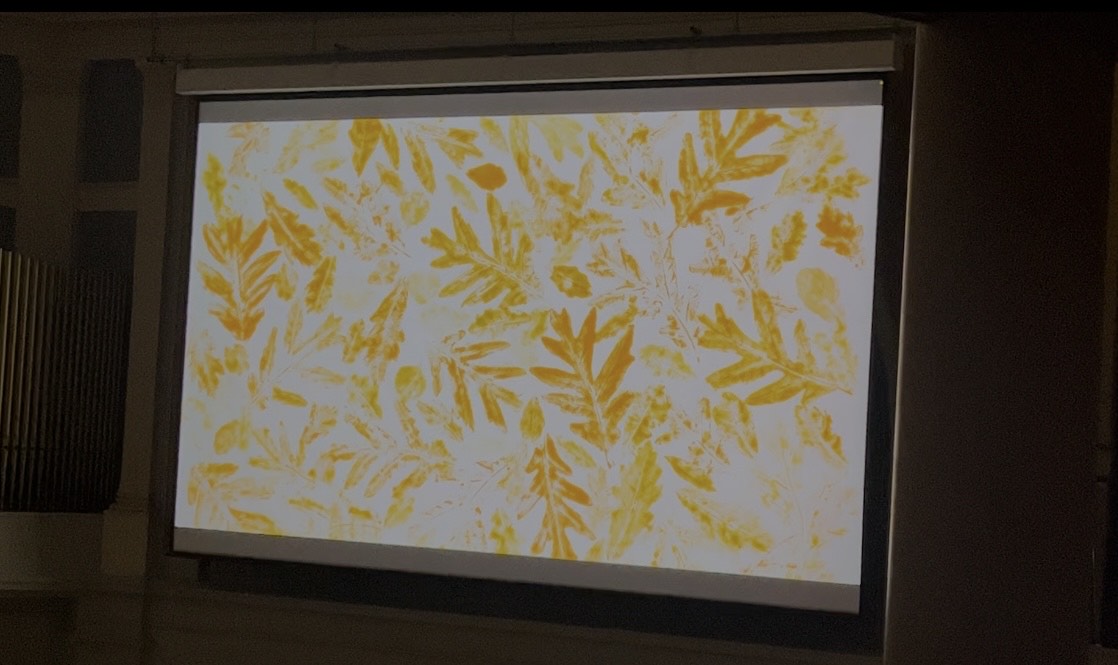
Other performers integrated natural elements and science into their showcases, such as in Oak Leaves Light by Sanda Iliescu & Matthew Burtner. The duo was commissioned by the Center of Forest Urbanism at UVA to create a piece for and based on the Campbell Oak Tree on UVA’s campus. By taking prints of leaves and using their geometry to generate sounds based on them, the pair created a visual slideshow and song. Playing music for plants helps them photosynthesize more easily, so the team plays their creation for them.
The pair wrote in their program biography, “The Campbell Oak Tree is older than the state of Virginia and obviously doesn’t need sounds to help it grow old. But by offering sound and form to help trees grow, we redefine humans as caretakers and protectors of the forest, rather than mere destroyers. Ultimately, we care for ourselves by caring for trees, in more ways than one.”
These individual showcases, together, created an unconventional and unforgettable night. The future of music technologies is as vast as performers’ imaginations, and according to TechnoSonics 2025, there are many bright prospects.