


Being a Nonbinary Parent
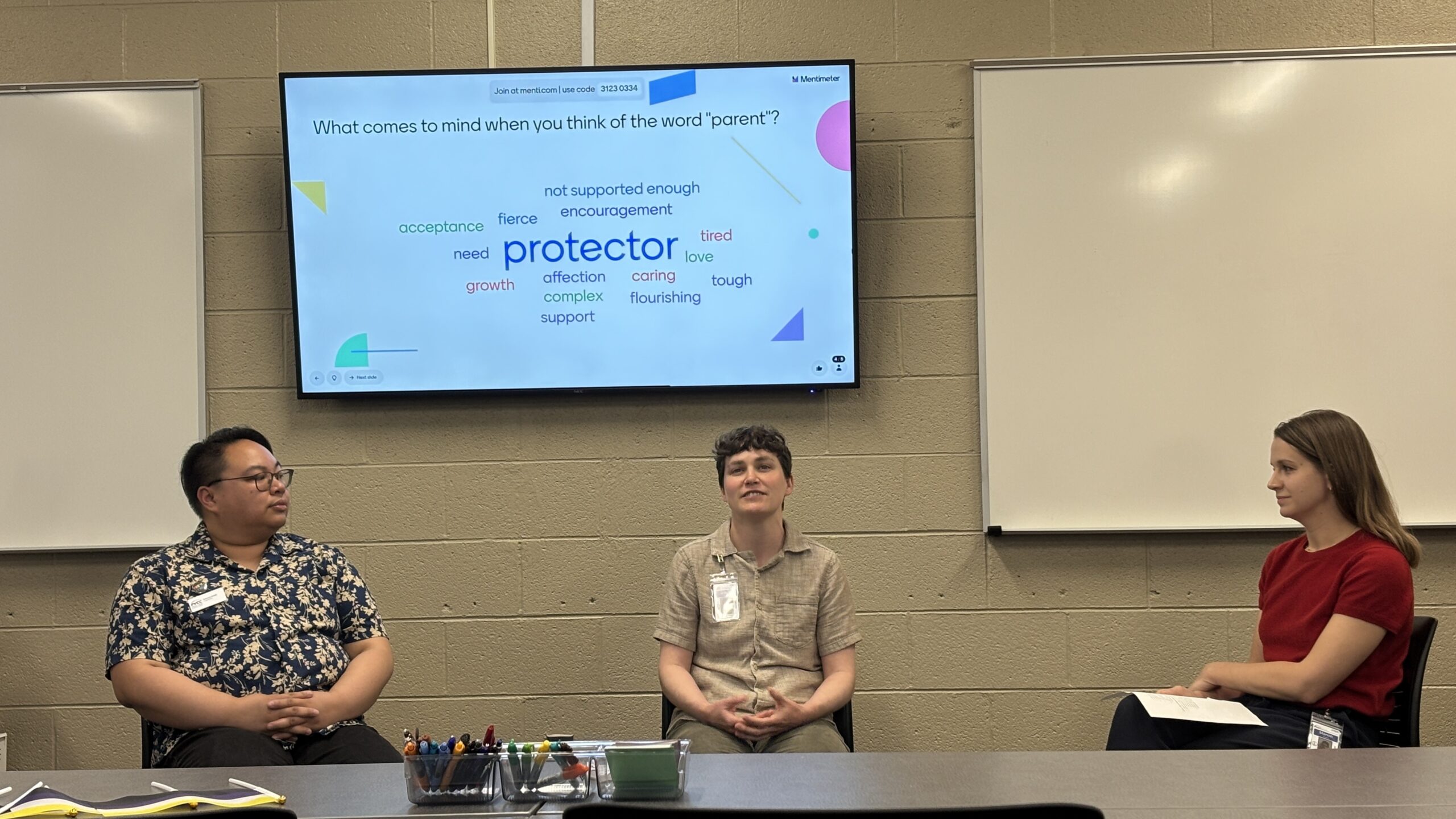
On Monday, April 13, the LGBTQ+ Club hosted a panel of two nonbinary PVCC staff members for Nonbinary Parents Day. The panelists were Suz Bayker, a workforce development operations support specialist, and Allyson Umali, a financial aid adviser and co-adviser for the LGBTQ+ Club. Bayker and Umali took the hour to share pastries and discuss their identities as being both nonbinary and parents in an inclusive and thought-provoking panel.
The panel, which was moderated by Manon Ehrlich, an assistant professor of English and co-adviser for the LGBTQ+ Club, covered a range of topics, including navigating pregnancy as a nonbinary person, support systems, fertility treatments, and grief. Bayker detailed how their experience as a birthing person helped them come to terms with their gender identity, and Umali took the audience through their journey as a non-birthing person dealing with the loss of a pregnancy due to preterm labor. The panel extended past a focus on just nonbinary parenthood and instead broadened its scope to parenthood as a whole with the added impact of a nonbinary identity.
Bayker offered insight into how it feels to be pregnant. “It very much ties very quickly to your identity because it is so strongly, physically happening to you,” they said. However, “you lose a lot of your autonomy,” Bayker went on to say. “Your body is not fully yours. It is yours, but you decided to share it, and it’s doing things without any control of yours whatsoever.”
Bayker described it as a “strange feeling” to suddenly have to think of their body in a different way. They highlighted that while there is a loss of control, it’s also a time to decide, “Who am I as a person who is pregnant and going through birth? What are the things that I can control, and what do I want in that?” Because of that decision, they were able to practice self-advocacy. Bayker concluded that they came out of their pregnancy impressed with their body and described it as a “very empowering experience.”
Umali followed Bayker up with their experience as a nonbirthing parent. They emphasized the importance of support for the birthing partner, such as taking on more tasks at home and, in Umali’s case, researching fertility treatments. Umali’s wife underwent fertility treatments like intrauterine insemination (IUI) and in-vitro fertilization (IVF), which require much more medical oversight and support. “Being educated is the main kind of takeaway for fertility because there’s so many words that they’re gonna use and so many dates that you have to keep in mind,” Umali advised. “So that will be helpful to be prepared for that.”
While describing their experience with fertility treatments, Umali was sure to mention that timing is key. Fertility treatments are heavily dependent on the natural functions of the patient’s body, which leads patients to meet many different doctors based on who is available at the clinic when their timing is right. Umali shared that they liked how fertility treatments need more monitoring than pregnancies without fertility treatments. Bayker commented that it’s “incredible” that people can become parents through fertility treatments.
The pregnancy journey, Bayker said, is slowly becoming more inclusive with things like medical forms asking for preferred names and pronouns as well as gender identity. “Going through the process of becoming a parent is already uncomfortable in a lot of ways — physically, emotionally — it’s all very new and different, and being able to have people really see you and respect you makes that uncomfortable experience a little more comfortable,” Bayker said. While there is still a long way to go, and the identities indicated on the forms are not always respected, steps are still being taken to recognize non-gender-conforming parents as birthing people.
Umali stressed the importance of mutual support among parents. While they supported their wife’s pregnancy, their wife also supported them emotionally and acknowledged their additional contributions to sustaining the household. Umali and their wife see a couple’s therapist as well as individual therapists. They thought very seriously about how a child changes a relationship. “How do we sustain what we feel for each other and support each other, plus our child?” Umali said. Their solution: focusing on other things that bring them joy together. Their communication and mutual support for each other helped them maintain their relationship throughout their fertility treatments and after losing their first pregnancy.
Bayker called back to the beginning of the event, when attendees were invited to answer a prompt asking what parts of their identities mattered the most to them. When making the decision to become parents, “you’re adding ‘parents’ to your identity,” Bayker explained, “as a parent, your life is very much about taking care of and protecting another, very vulnerable person.” They concurred with Umali on keeping the other parts of their identity in mind. When they focus on what makes them happy, they become a healthier parent. “The better I feel, the better I can show up for my child in difficult moments,” Bayker said.
Navigating life as new or prospective parents is difficult, especially for queer couples. Bayker and Umali both gave emphasis to a strong support system for parents. Umali reiterated the helpfulness of therapy as both individuals and as a couple. “I’m a big proponent of mental health and helping through there,” Umali said. They continued by advising new parents and people experiencing loss to keep in mind “the people that will support you no matter what you go through and people who will be there.” Even simple gestures like checking in; gifting flowers to say, “I’m thinking about you;” and ensuring that their basic needs were met with delivery gift cards while they were grieving are important modes of support. Bayker shared that supportive and accepting friends and family, as well as connecting with other parents, meant a lot in their parenting journey as well.
Childhood is a gendered experience, and an issue many queer families face is introducing their children to the idea of gender as a less binary construct. Bayker’s child calls them “Moony.” They’ve worked to introduce their child to the many different ways that a family can look with inclusive books. “Some children have a mom and a dad; some children have a mom and a mom; some children have a dad and a dad; some children have a moony and a mom,” Bayker said. Ultimately, they try not to make gender a focus of their child’s life and allow things to come naturally.
The experiences of nonbinary parents like Bayker and Umali present parenthood as a much less gendered affair, opening up opportunities for less binary views around navigating parenthood. Discussions for different experiences with parenthood also allow for people like Umali, who lost children to complications during pregnancy, to embrace “parent” as a part of their identity and accept how it influences them. Nonbinary Parents Day takes place on the third Sunday of April every year.
“This too shall pass,” Bayker said regarding when parenting gets hard. “We’re all gonna be who we are, that love each other and make it happen.”