



Pixar Echoes its Golden Age with “Hoppers”
In a film age full of sequels, adaptations, and live-action remakes, an original animated movie is always good to see. Pixar has had its ups and downs in recent years when it comes to commercial success in this regard, but Hoppers (2026), directed by Daniel Chong, is certainly an up. The film has a classic feel that hits every mark — emotion, a lesson, an engaging story, and characters full of heart — and Pixar’s signature tear-blurred glow that extends past the screen.
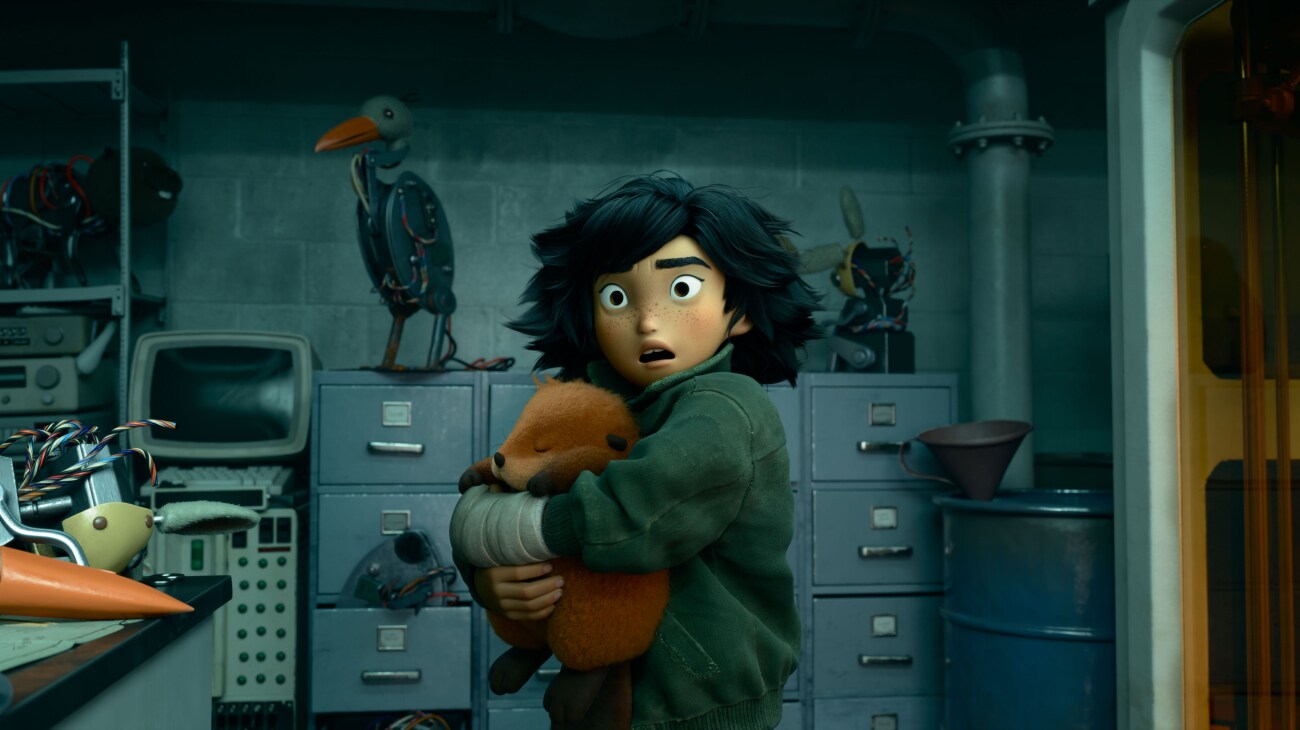
The movie follows the spunky Mabel Tanaka (Piper Curda), a 19-year-old wayward college student at Beaverton University with a passion for environmentalism, as her boundless curiosity and daring lead her to hijack a secret technology that enables wildlife researchers to closely observe animals in their natural habitats. The technology, known as the “Hoppers” program, takes the human consciousness and transports it into a robotic animal. After “hopping” into the robot, researchers are able to blend in and even communicate with other animals.
“Like Avatar,” Tanaka comments in the film.
“This is nothing like Avatar,” Dr. Samantha “Sam” Fairfax (Kathy Najimy), Tanaka’s biology professor who heads the project, exasperatedly refutes.
Animated films, as many creators like Brad Bird and Guillermo del Toro will affirm, are not necessarily kids’ movies. Animation is not a genre. It’s an art form, a medium. That being said, animated films are largely family-friendly and thus tend to have a lesson. Beyond the wide emotional lesson in Hoppers — coping with loss, especially — is a very academic one. Hoppers educates its viewers on the importance of beavers to their environment as a keystone species. In fact, the entire film cinches on Tanaka trying to track down a beaver to reintroduce wildlife to a forest glade that is special to her and her grandmother to prevent it from being overtaken by the construction of a freeway.
Chong actually discovered the importance of beavers to their ecosystems while developing the film, which was originally conceptualized as a penguin movie. After stumbling upon the role beavers played in restoring balance to Yellowstone National Park, it became clear that they had to be the focal point of the movie.
“These little guys deserve to be stars,” Chong said.
Using a robotic beaver she’s commandeered from the Hoppers program, Tanaka leaves the human world behind to enter the animal kingdom, excitedly interacting with animals while she works to track down a real beaver to bring balance back to the ecosystem in the glade. She uncovers a whole new world of organized wildlife, headed locally by King George (Bobby Moynihan), a loveable beaver with a crown that maintains order in a rather literal animal kingdom. To the disbelief of both Tanaka and the researchers monitoring her actions, there are a lot more similarities between the human and animal worlds than they ever could have fathomed.
Tanaka radicalizes the animals against the humans, particularly the mayor of Beaverton, Jerry Generazzo (Jon Hamm), who is building the freeway. When her push to reclaim the glade goes too far, however, she is forced to reckon with the consequences of her actions as she scrambles to keep both the human and animal communities safe.
Hoppers is a fantastic film that has already cemented itself as a success for Pixar. The film opened globally to an estimated $88 million in its opening weekend, according to Comscore, a media data analytics company. It’s the biggest global opening for an original film this decade. As of March 9, Hoppers sits with a 93% on Rotten Tomatoes’ critic-based Tomatometer (Certified Fresh) and a 94% on the audience-based Popcornmeter (Certified Hot). The film originally debuted with a 98% on the Tomatometer after prescreenings.
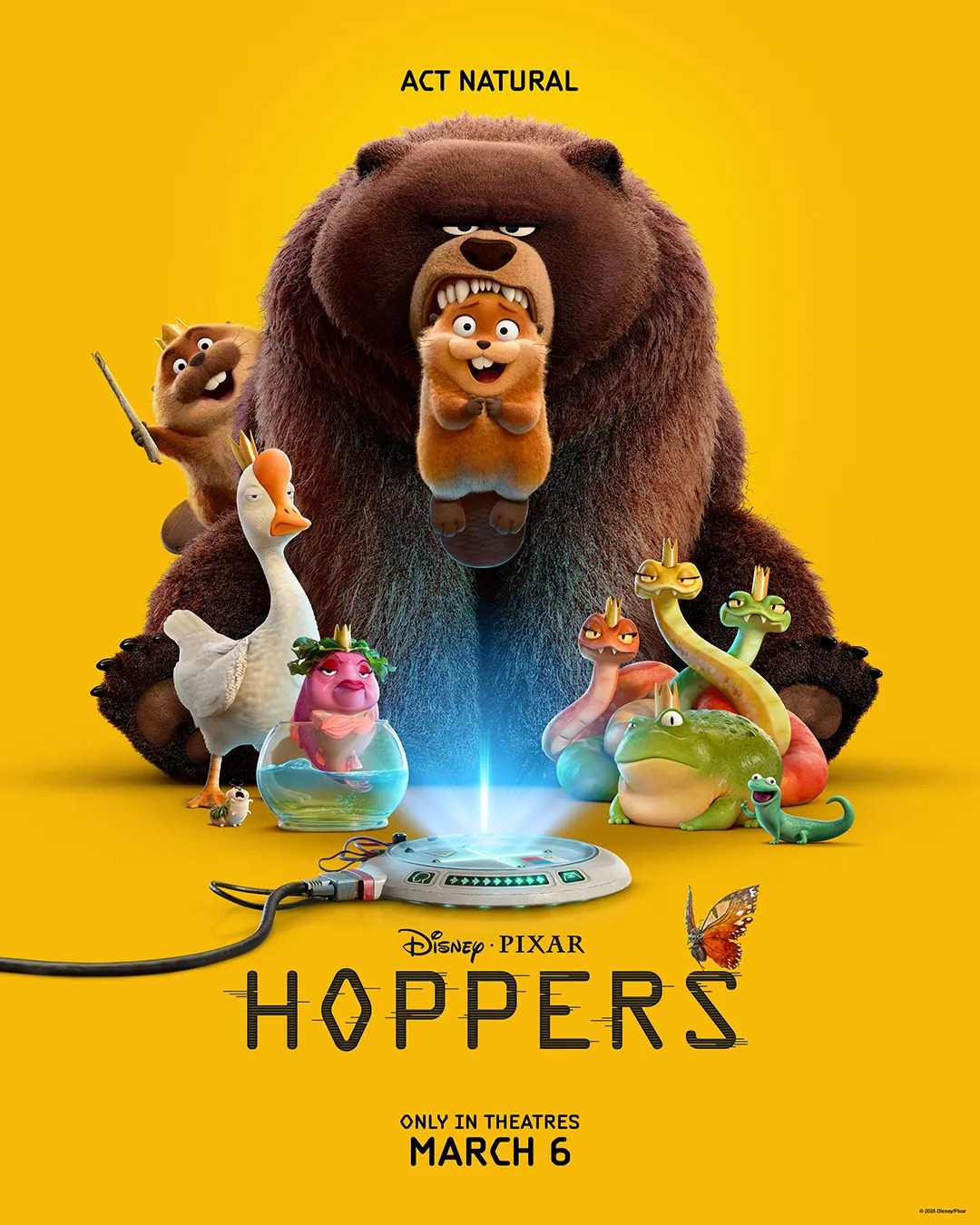
One aspect of the film that really stands out is the animation choices surrounding the animals. At the beginning of the film, as well as in all other scenes where Tanaka is in her own body, animals appear as, well, animals. Their eyes are beady, their faces lack most discernible emotion, and their movements are distinctly animal-like. When Tanaka’s mind enters the robotic beaver, however, everything shifts. The animals become more cartoonish in their appearance and behavior, appearing much more similar to the humans in the film. When Tanaka enters their world, she bridges the gap between human and animal and gets to know the animals as personable characters. This animation trick is not unique to Hoppers — it’s a callback to films like Disney’s Brother Bear (2003) and Studio Ghibli’s Pom Poko (1994). The difference between the expressive character models when the animals are being perceived by each other versus the more realistic models when perceived by humans adds a certain charm to the movie that effectively communicates the lack of connection animals have with the human world.
A tidbit from the film I really enjoyed is the quick and easy introduction of what the animals call “pond rules.” When studios know movies are going to attract a younger audience, they tend to skirt around highlighting the food chain in talking animal movies. Once animals are able to talk, they become humanized in the eyes of the audience, and then seeing a predator standing side-by-side with a prey animal becomes a bit awkward. In Hoppers, the writers breezily explain that animals are still wild in the animal world, and follow pond rules: If you catch another animal, it’s fair game to eat them. Prey animals understand this rule fair and square and accept their place in the food chain, much to the disbelief of Tanaka.
The world in Hoppers feels both big and small. There is no grand adventure — the setting is limited to the town of Beaverton and the surrounding areas inhabited by wildlife — but the story manages not to feel too contained. The personality of a local feud crosses with the breadth of nature in a distinct and natural way.
“It’s hard to be mad when you feel like you’re part of something big,” Tanaka’s grandmother tells her early in the movie as they take in the quiet beauty of the glade, advice that Tanaka takes to heart.
A lot of research went into the creation of Hoppers. The filmmakers worked with Hoppers consultant Dr. Emily Fairfax, PhD — note the same surname as the professor in the film — to learn as much as they could about beavers to ensure the film was authentic where it needed to be. They spent a week in Yellowstone National Park and traveled to Colorado to swim in real beaver ponds. Fairfax shared her excitement about the learning opportunities the film presents for people to get to know more about the importance of beavers.
“There is no way I could reach as many people through a peer-reviewed paper as will be reached through this movie,” Fairfax said.
The humor in Hoppers doesn’t feel tired, overdone, or too childish. There are jokes for the whole family, both ones that transcend maturity and a couple of hidden quips for the adults in the theater. The filmmakers knew Hoppers was going to be zany and absurd from the start and kept up the energy throughout the scripting and animating of the film.
“The thing that always guided us was the comedy and the characters,” Chong said. “That was what we chased the hardest. We knew it was our team’s strong suit, and we made sure early on to establish a unique comedic tone with fun characters to build everything on.”
Hoppers is not about to be Disney’s new franchise, and it doesn’t need to be. Hoppers is a perfect example of a proper standalone film — nothing needs to come before or after its story. The plot neatly resolves itself within the one hour and 45-minute runtime of the movie, and while the ending shows that there is always more to do, it still implies that the rest of the characters’ stories will take place off-screen. In fact, a couple easter eggs at the end even hint at how Hoppers fits into a broader Pixar storyline with the likes of Cars (2006) and Monsters, Inc. (2001).
Hoppers is the kind of film audiences can’t help but recommend. Walking out of the theater, there is a sense of purpose to gush to the next person you talk to about how amazing the movie is. It’s refreshingly nuanced and reflective, with deep, fleshed-out characters that feel real. The film advocates coexistence without feeling preachy, and acknowledges both Tanaka’s flaws and Generazzo’s well-meaning. The film feels neither cartoonish nor black-and-white, allowing for a legitimate and believable story to thrive. Hoppers is a story about defiance, belonging, and unexpected alliances full of laugh-out-loud quips as well as moments sure to tug at the heartstrings of even the most resolute viewer.
“See it in theaters,” Lyon Liew, the tailoring and simulation supervisor for the film, said in a post on X (formerly Twitter). “It’s meant for the big screen.”
Hoppers is rated PG and is currently available to watch in theaters worldwide.