

The Untold Egyptian Story at The Fralin
Four thousand years ago, a man sits and strings his longbow.
His name is Nenu. He lives at home with his wife, Sekhathor, and two children, one son and one daughter. He has two dogs, potential ancient ancestors of the modern-day Kelb tal-Fenek, or Pharaoh Hound, breed. A man named Genu, perhaps a servant, stays close to him. They likely live just southwest of Thebes in El-Rizeiqat or Jebelein, Egypt.
As an accomplished bowman, Nenu holds status in both life and death. When he dies, the king of Egypt will send his family a funerary stela depicting this scene: Nenu, his family, his servant, and his dogs. He will be shown holding his longbow and quiver, the symbols of his archery for which he is respected by the king. An inscription upon the stela will describe him as “the revered Nenu.”
Despite living in Egypt and earning the admiration of the king, Nenu is not Egyptian. The inscription on his funerary stela will label him as “Nehesi” (the Nubian).
Nubia, geographically, is the area between the First and Sixth Cataracts of the Nile River that is now present-day Sudan. Nubia was not a monoculture but was singularly treated as a southern land of others by Ancient Egyptians. Lower Nubia — which is actually the northern part — was called “Ta-Seti” by the Egyptians, or the “Land of the Bow,” after its reputation for producing skilled archers. This mysterious region of archers is where Nenu is from.
The history and culture of Ancient Egypt has been well-communicated around the globe, but the relationship between this ancient civilization and the lands surrounding it has been comparatively neglected. The history of colonization, assimilation, and adaptation between Egypt and Nubia, especially through a perspective focused on Nubia, is seldom highlighted. “The World Between: Egypt and Nubia in Africa,” an ongoing exhibition at The Fralin Museum of Art at UVA, explores the intermingling of these cultures through art history.
The title of the exhibition, “The World Between,” comes from the blend of cultures that derives from geographical nearness. Politics and borders aside, the sociocultural influence between Egypt and its southern neighbors is undeniable. Nenu, for example, was likely among the many Nubian migrants that came to Egypt to put his skills to work as a soldier. He would have experienced firsthand the multicultural lifestyle of Nubian communities within Egypt; in his funerary stela, he and his children are depicted wearing Nubian clothing while his wife is imaged in Egyptian wear.
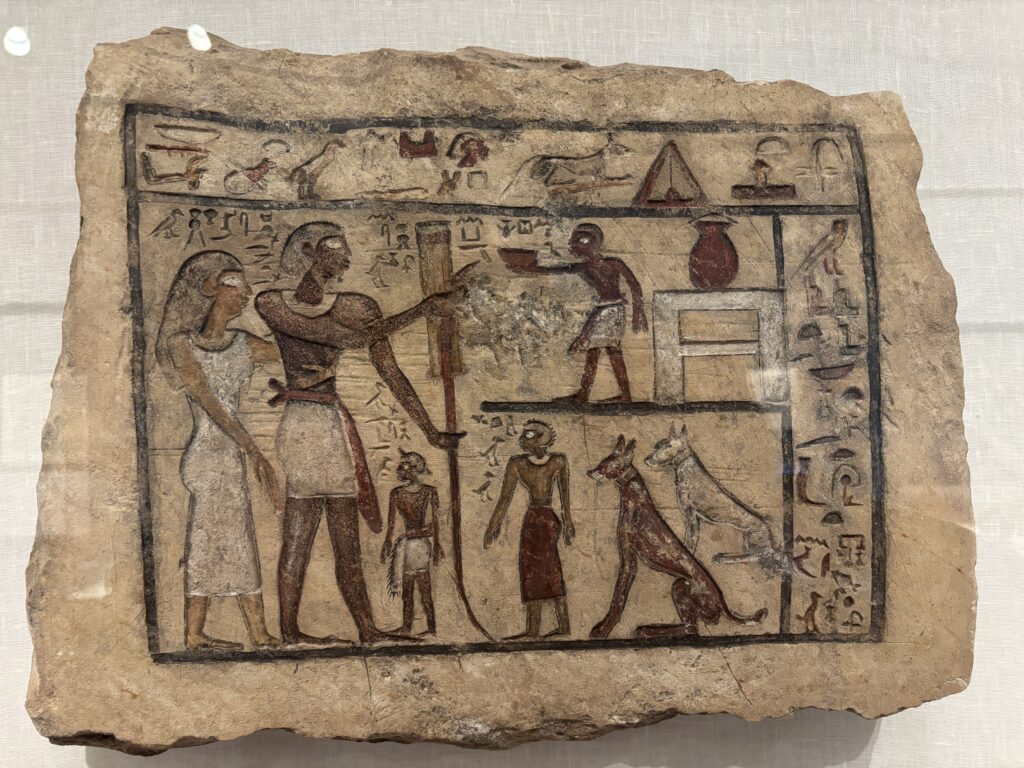
The label beside “Stela of Nenu and Sekhathor,” the funerary image gifted by the king, points out a glaring issue with this depiction: “It is difficult to know how these individuals self-identified in everyday life.” Nenu was Nubian, but archaeologists have no way of knowing how much he expressed his culture during life. The stela is, ultimately, Nenu and his family through the eyes of the Egyptian king. Much of Nubian culture is documented from an Egyptian perspective, so the level to which portrayals of Nubians are stereotyped in Egyptian art is unknown.
This is the focus of the exhibition: multiculturalism in ancient times. Just like in the present day, migrants from one culture to another find themselves caught between opportunity and oppression, bias and belief.
“This exhibition shows that people in the past were as complex as they are today,” Anastasia Dakouri-Hild, the professor of art history at UVA who curates the exhibition, told Cavalier Daily.
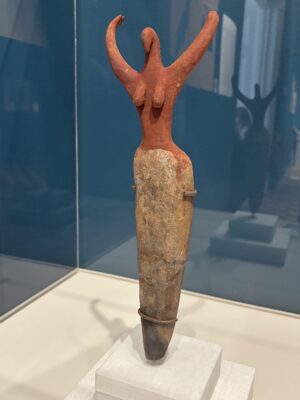
“The World Between” invites its guests on a journey through ancient times, narrated by artifacts spanning thousands of years. The first artifact guests encounter is “Female Figurine with Raised Arms,” dated ca. 3600-3500 BCE. According to the accompanying label, “Its form, especially the lower body, finds parallels in both Neolithic Egyptian and Nubian imagery.” These similarities point to a shared history between the two cultures.
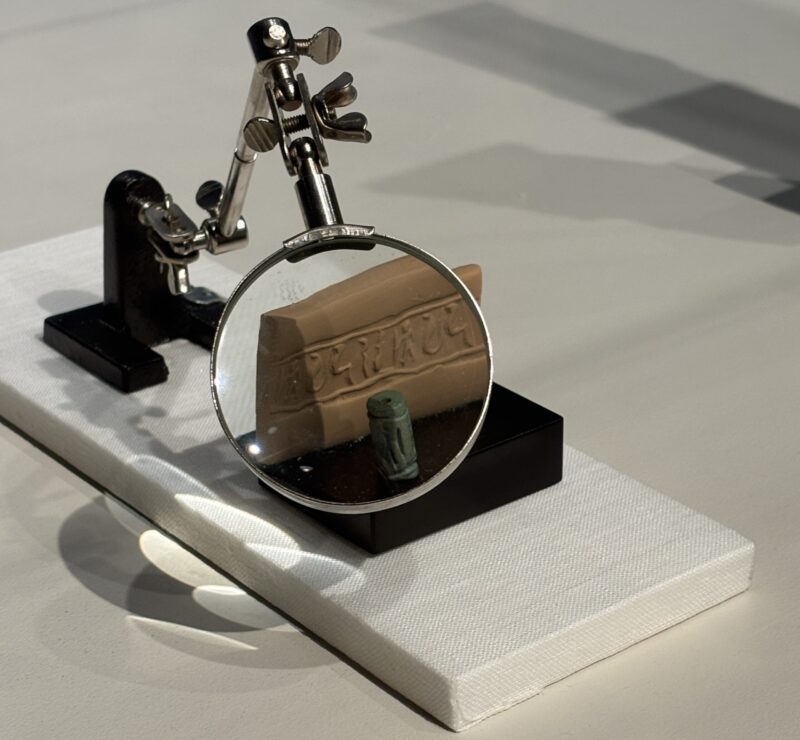
The exhibition continues, leading museum-goers down a winding path decorated with more artifacts and slowly advancing through time. The final artifact displayed is an archer’s finger loose, a thumb ring designed to help with aiming an arrow. Finger looses, as described by a website linked to a QR code offering more information on the artifact, are usually connected to the Meroitic and Post-Meroitic eras, two thousand years after Nenu lived.
“The World Between: Egypt and Nubia in Africa” separates itself from other exhibitions at The Fralin by being purely archaeology-focused. The exhibition focuses on art history rather than just art, utilizing ancient designs to illustrate a snapshot of the past. Museum-goers find themselves separated from these ancient cultures only by a pane of glass, empathizing across millennia. Figurines, statues, beaded jewelry, tableware, stelae, and tools, all crafted thousands of years ago, sit only inches away.
The exhibition offers other displays to further immerse attendees in its history. 3D-printed reproductions of figurines, a “reserve head,” and an incense bowl invite viewers to touch something similar to the artifacts. Videos documenting more information are projected onto the walls of the exhibition. Updates on where patrons are in history are provided throughout the walk, accompanied by a timeline and a map. Every exhibit has a scannable QR code that leads to a page with more information on a given display.
“The World Between: Egypt and Nubia in Africa” opened on Aug. 30, 2025, and will be displayed until May 31. The Fralin Museum of Art offers free admission and has limited on-site parking at its location on 155 Rugby Road, Charlottesville, VA. The museum is open from 10 a.m. to 5 p.m. on Tuesdays, Wednesdays, Thursdays, and Saturdays. The museum hours on Sunday are noon to 5 p.m., and the hours on Friday are 10 a.m. to 8 p.m. The museum is closed on Mondays. “The World Between” is available during all opening hours and is located directly to the left when walking through the main entrance of the museum.