The Longest Table Offers New Perspectives
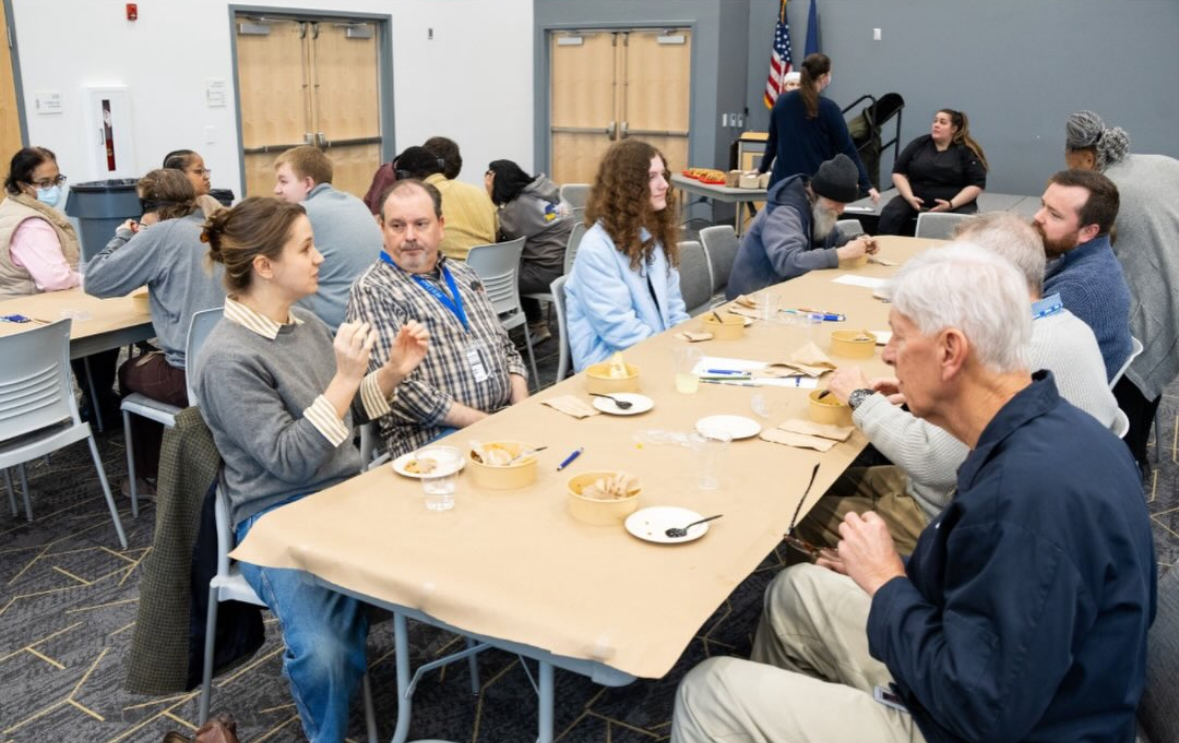
On Wednesday, Feb. 11, students, faculty, and staff at PVCC followed the warm aroma of various soups into the Bolick Center Event Space for the second annual The Longest Table. The PVCC Longest Table event encourages people to try something new over a meal. Last year, participants were randomly assigned tables to sit next to strangers and meet new people. The theme of this year’s Longest Table was “Shifting Perspectives.”
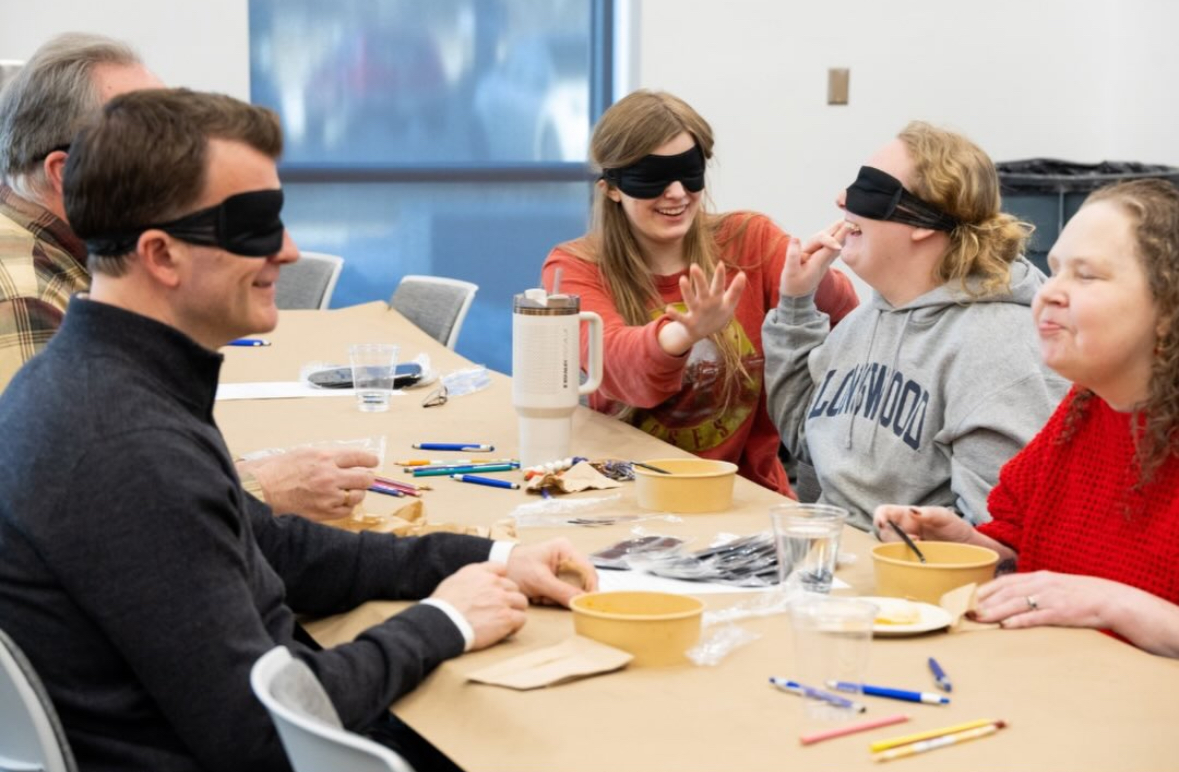
Attendees were invited to sit at eight different tables with four different accessibility issues. They were instructed to fill their bowl with their soup of choice and pick a new hindered perspective: sight, dexterity, voice, or hearing. The “Dining in the Dark” table offered blindfolds, “The Adapted Hand” forbade the use of the dominant hand, “The Silent Connection” disallowed speaking, and “The Muffled Word” dampened guests’ hearing with earplugs.
Across a shared meal of soup, bread, and cookies prepared by culinary students at PVCC, people bonded with both familiar and unfamiliar faces. The tables were covered with brown paper in place of tablecloths and littered with pencils and pens to write down reflections. After the meal, guests left their thoughts on how their newfound impairments affected something as simple as eating:
“Took too much thought to eat,” reads a message written on the dexterity table. “I will never take my dominant hand for granted.”
“The experience of eating was so different,” a note from a blindfolded participant observes. “I had to keep one hand contact with the bowl. Every bite was a little surprise about what was in the spoon!”
As well as interacting with others:
“I found the quiet enjoyable,” one person with earplugs says in writing. “Yet, I also found I was less inclined to interact with others.”
“When talking or listening is gone, you need to rely more on sight, and so if you’re not looking, you’re missing a lot,” wrote a participant on the “Silent Connection” table.
The effect the artificial accessibility issues had was immediately apparent to everyone participating. Communication and conversation adapted according to their needs. The notes and messages left behind detail these experiences, and the voiceless table wrote the most by far. With the option of verbal communication eliminated, they began communicating through gestures, expressions, and scraps of conversation scribbled onto the table:
“Food allergies.”
“Potato.”
“8 chinchillas?”
“DO RE MI FA SO LA TI DO.”
“More soup!”
“What u study?”
“Wrong table for chatters,” one message wonders, “or right table!”
Sometimes, entire exchanges were contained to writing.
“Is it rude to drink out of the bowl?” Asks a person nearly finished with their soup.
“NO!! Ruder to waste!” Another responds.
“My mom would disagree.” The first writes back.
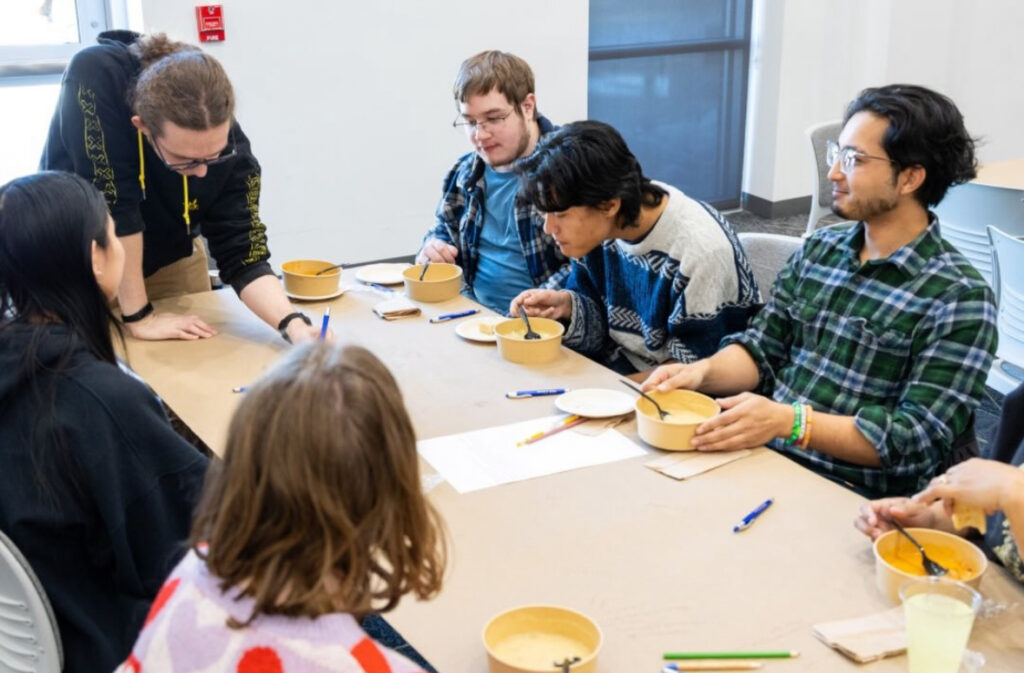
When speaking, it’s easy to emphasize certain words. When typing, italicization conveys the same tone. Restricted to handwriting, people started to underline important words instead.
“Would this be easier if we knew sign lang.? Because [we] need hands to eat.”
“They have more cookies too.”
“She says bye like she’s movin out of town.”
“Fur Elise.”
“How do I sign too?”
The remnants of conversation are easiest to track on the “Silent Connection” table. With everybody already equipped with writing utensils, there were not only words left behind, but also drawings, arrows, lines, scribbled-out miscommunications, a music score, and a tic-tac-toe game. Many people wrote upside-down to communicate with those across the table, shakily correcting the occasional backwards letter.
The purpose of The Longest Table was to expose the PVCC community to different ways people interact with the world. Those eating were encouraged to reflect on their experiences and came out of the meal with a new outlook on accessibility and a newfound appreciation for their senses.
“I learned that I would rather be deaf than blind,” says a message from the blindfolded table.
“I realized how much your hand usage impacts one’s ability to follow many dining customs & rules,” a person using their non-dominant hand wrote. Another simply wrote, “Ain’t easy.”
Several people left behind messages written with both their left and right hands to demonstrate the gap in dexterity. Trying it for oneself reveals a script that is large, wobbly, and childlike. Participants at this table noted a tendency to write some letters, especially “e”, backwards. The writing from non-dominant hands offered a glimpse back to learning how to write in childhood, when it was new enough of a skill that kids lacked the muscle memory and dexterity most adults have now, and consequently wrote their letters in a similar fashion.
People with experience with certain accessibility issues also attended The Longest Table, and participants were eager to learn from them.
“The ASL signs develop like language, so mine are outdated,” one person with American Sign Language experience wrote at a voiceless table. Another ASL user sat at the other “Silent Connection” table, and a cluster of scribbled messages asked how to say certain words, discussed learning the language, and mentioned people who use it.
“I want to learn ASL,” one person concluded.
The blindfolded table was perhaps the most engaging table to sit at. Dr. Sandra Bullins, a student success coach and College Success Skills professor at PVCC who helped plan the event, sat without a blindfold, answering a barrage of questions from a gaggle of blindfolded disciples. Bullins, who has been completely blind since she was 22, offered her perspective on the different tables.
“I kind of lived each experience,” she said. Apart from being blind, she’s had an ear infection that impaired her hearing, bronchitis that prevented her from speaking, and carpal tunnel surgery that hindered the use of her dominant hand. The most difficult thing for her was not being able to use her right hand. “It was not fun, but I survived. I did survive,” she said with a laugh.
One person sitting at the same table wanted another serving of soup and opted to keep her blindfold on and let another person sight guide her through the process. Upon her return, she shared her experience trusting someone else to navigate.
“It takes a lot to trust somebody,” Bullins said on sight guides. She places a lot of trust in her guide dog, Wiggles, who lay next to her seat for the duration of the meal.
“You never know what you’re capable of until you’re faced with it,” she told her blindfolded audience. “You get used to it. You adapt, and I think that’s kind of human nature: that we adapt.”
Bullins can’t take off a blindfold or turn on a light to regain her sight, and she’s content with that. The Longest Table allowed others to briefly share her experience and understand her perspective.
“Whole new understanding. Whole new level of respect,” a friend of hers from the other “Dining in the Dark” table said.
Bullins encourages students to step outside of their comfort zones and try new things like The Longest Table. “I hope that people who attended The Longest Table…left with a new appreciation for some of the battles that people go through every day,” she said.
“I think the experience today was really positive,” Bullins said about The Longest Table. “Our hope was that people would take away more awareness, and I think that happened.”