


1 Billion Years of History in Our Backyard
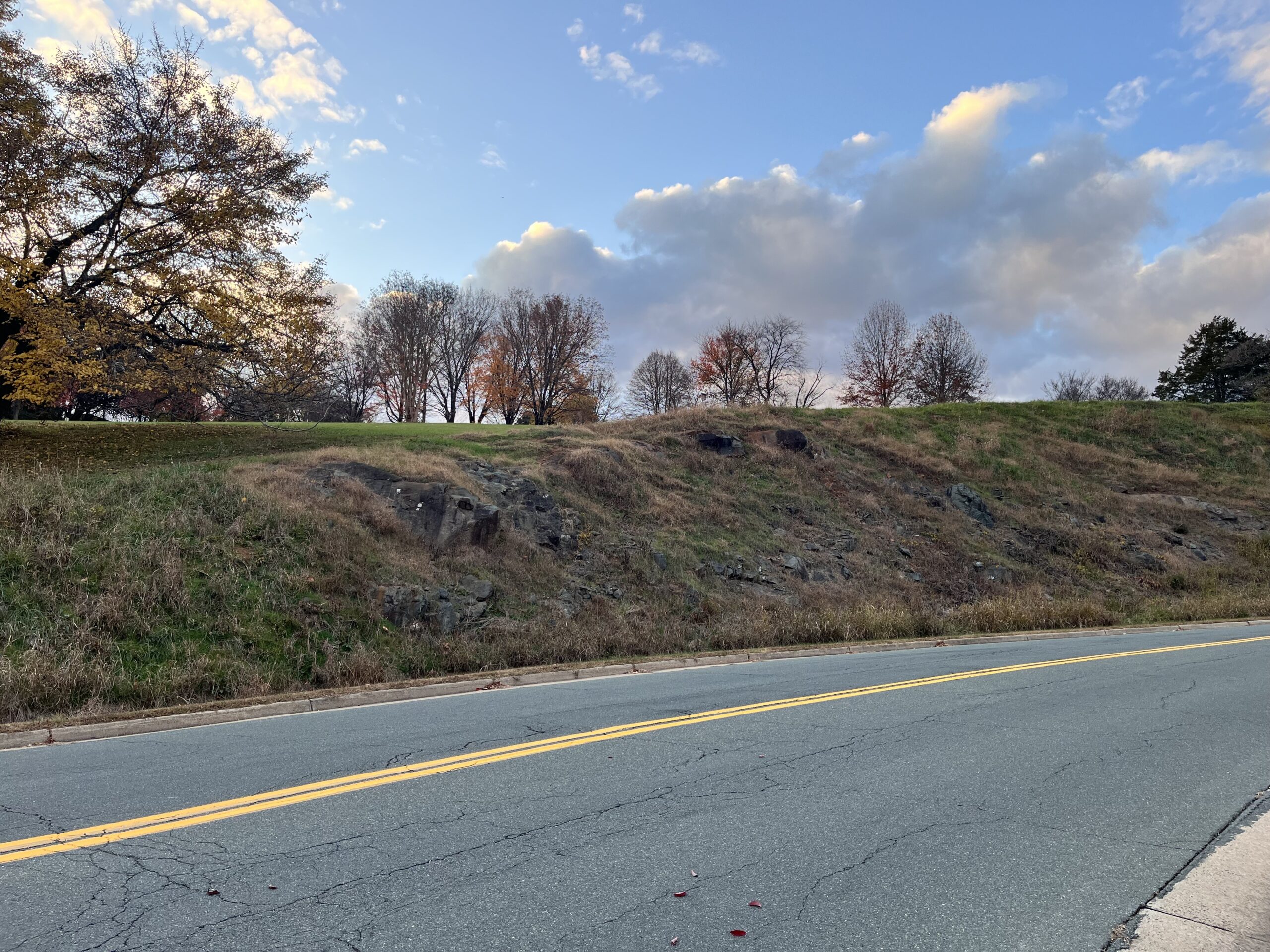
When students look out from the hilltop PVCC rests on, they can get amazing views of Carter Mountain and the Blue Ridge Mountains, peaking up from the horizon. On campus, large green-tinted outcrops greet visitors and students alike on the drive up the hill to class. Small tan cobbles line the parking lots and walkways, but some have ancient fossils peppering the sides. These sights span from mundane to breathtaking, and geologists can read these rocks like history books. Together, these scenes can tell over a billion years of Charlottesville’s geologic history. The very land on which the college sits has witnessed everything Mother Nature has to offer, from the depths of the ocean to volcanic eruptions, and even the violent collision of supercontinents on top of it all. The rocks below PVCC’s campus have a story to tell, if one knows how to read them.
Plate tectonics is a powerful force, and it explains how entire landmasses can be shuffled around the globe so easily. The Earth is not solid rock all the way through; beneath the solid crust that we walk on is the mantle, made up of superheated, thick, churning rock. The continental crust is only about 15-25 miles thick, so compared to the nearly 8,000-mile diameter of the globe, the crust only makes up a fraction of Earth. As the liquid mantle gets heated by the core, it surges and falls like the oil in a lava lamp. Warm rock rises due to its low density. As it gets to shallower depths with less pressure, this hot rock begins to melt. This process is called convection, and it leads to the solid crust on top cracking and riding the surface of the mantle. This process has been happening for billions of years, bringing large landmasses together and ripping them apart.
This story begins 1.2 billion years ago, when the continents were unrecognizable. The Atlantic Ocean was nowhere to be found, and instead, a massive supercontinent named Rodinia (Russian for “homeland”) stood in its place. All the continents on Earth were once bundled together, merging into one landmass after smashing into each other as tectonic plates were pushed together from below. This collision is called the Grenville Orogeny, and it left behind the ancestors of the Appalachian Mountains, the Grenville Mountain Range. Before billions of years of rain and wind eroded them down, these hills were massive, similar to the Himalayas today. Below trillions of pounds of material on top, magma sat in the belly of the mountains, slowly cooling in their insulated chambers. This magma cooled into granite, the same kind one might find on kitchen counters at home. While these granite deposits are too deep in the hill to be seen from PVCC’s campus, they can be found elsewhere in Charlottesville, where they’ve been eroded out, like at Ivy Creek Natural Reserve or Ragged Mountain Reservoir. These granites are among the oldest in Virginia and the lowest rocks in the geologic sequence, called the basement complex.
Even Rodinia was not impermeable to the forces of tectonic plates and was broken apart after only 250 million years. As the ground split below, gaps opened up, and magma breached the surface as lava that flowed across the landscape. The lava flooded out of cracks in the ground, filling in valleys, smoothing the landscape, and leaving behind a thick stack of dark rocks in its wake. The lava then cooled and solidified, turning into a jet black rock called basalt. Fresh lava deposits like these didn’t stay pristine for long, as in about 100 million years, another, more well-known supercontinent was shoved on top of these outcrops.
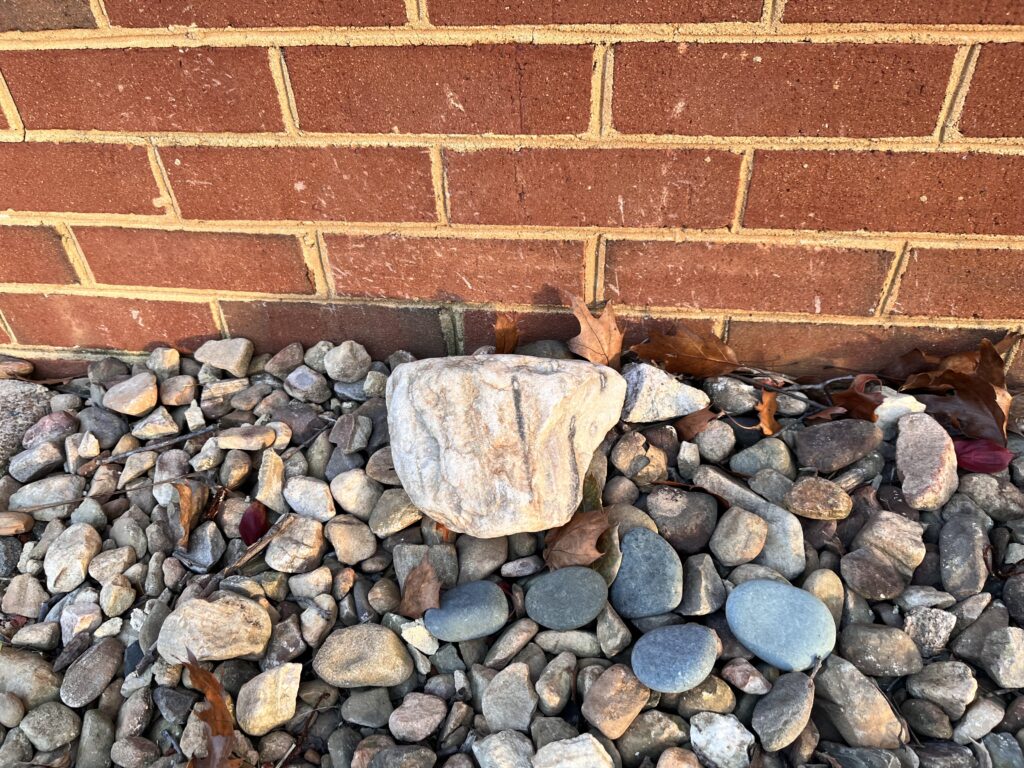
As Rodinia broke apart, the Iapetus Ocean, predecessor of the Atlantic, opened and flooded eastern Virginia up past central Virginia to the base of the Blue Ridge. At the same time, the Grenville Mountains eroded and crumbled, depositing pieces that ground down into sand on the ancient beach west of Charlottesville over 560 million years ago. These sands lithified into sandstones and are called the Antietam formation. Many horticulturists use Antietam Sandstone pebbles as landscaping rocks, and the rock beds next to PVCC’s parking lots are chock-full of them. At the Iapetus shoreline near modern-day Afton County, extinct ocean worms called Skolithos dug vertically into the sand and left their burrows behind. The Antietam sandstone seen today is speckled with fossils of tunnel casts from the creatures, and these worm casts are the oldest fossils in Virginia. Outcrops of sandstone with Skolithos tunnels can be found along Skyline Drive, such as at Turk Mountain. Eroded from these outcrops, cobbles travel eastward in riverbeds or end up in commercial rock beds as filler rocks, like next to PVCC’s main building.
Like Rodinia, once it was open, the Iapetus Ocean was at the mercy of tectonics. It zipped closed south to north about 355 million years ago, creating the most recent supercontinent, Pangea. Africa rammed into North and South America 300 million years ago, uplifting the Appalachian Mountains and creating a pressure cooker of heat and weight for the solidified lava that flowed within. The heat and pressure transformed all the basalt into a new rock called greenstone, which underlies much of the eastern Blue Ridge region (Despite its name, Piedmont Virginia Community College, ironically, lies within the Blue Ridge and not the Piedmont). Greenstone, as the name suggests, takes on a green tinge from the chemicals chlorite and epidote, and there is a massive greenstone boulder on the left hill of PVCC’s entrance road. This greenstone blanketing the landscape is named the Catocin Formation, after Catocin Mountain in Maryland.
These pieces of the puzzle come together to tell one cohesive story of central Virginia’s past. First, the oldest and deepest formations under the surface are the granites of the basement complex from the Grenville Mountains that formed 1 billion years ago on Rodinia. Rodinia began rifting apart 750 million years ago, opening the Iapetus Ocean and creating channels for fresh lava to flow up and be deposited on the surface. Once the lava cooled, it turned to basalt, the beginning of the Catoctin Formation. The Grenville Mountains eroded at the same time, dropping sand, mud, and gravel, creating the Antietam Formation on the then shorelines of Virginia about 560 million years ago. The sandstones in the Chilhowee Group are named the Antietam Formation and contain trace fossils of marine tunnelers within them. The Iapetus Ocean closed, and Africa collided with Virginia, uplifting the uneroded Appalachian Mountains. The pressure this created changed and melted the Catoctin Basalts into Catoctin Greenstone that can be seen today.
Altogether, it’s clear that Charlottesville has a rich and varied geologic history, and PVCC is in the heart of it all. If students find rocks and geology compelling, they can consider visiting the geology club (Wednesdays 12:45 p.m., M850) or taking a class! Physical Geology (GOL105) and Historical Geology (GOL106 ) are both offered in the spring and fall, respectively, as a science with a lab.